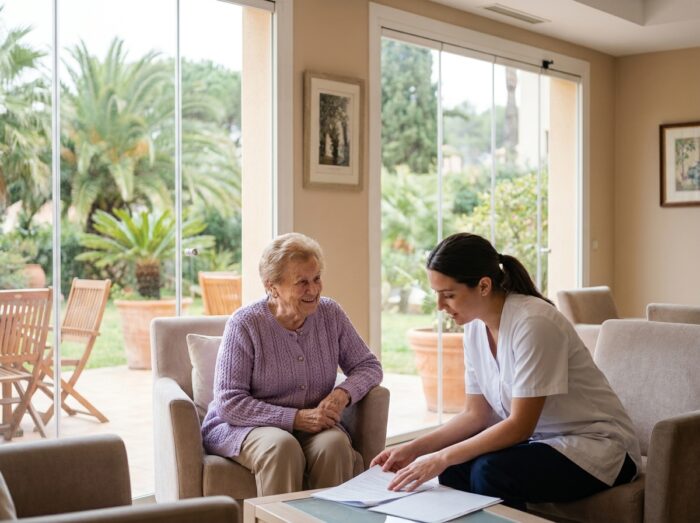
A nursing home in Cagnes-sur-Mer refers to a facility for dependent elderly people (EHPAD) located in this municipality of the Alpes-Maritimes. The city has several medicalized structures, each with its specificities regarding care, living conditions, and support for age-related pathologies. Choosing a suitable establishment requires understanding what truly distinguishes one residence from another, beyond the brochures and stars displayed in directories.
Assessment of loss of autonomy: the starting point for choosing an EHPAD
Before comparing residences, the first step is to objectively assess the level of dependency of the future resident. The GIR grid (Groupe Iso-Ressources), used by the medical-social teams of the department, classifies elderly people into six levels. Only GIR 1 to 4 are eligible for the APA in an establishment, which directly affects the remaining costs for the family.
This classification also determines the type of unit that is appropriate. A person classified as GIR 5 or 6, still relatively autonomous, is more suited to an assisted living residence or home care. A GIR 1 or 2, with advanced cognitive disorders, requires a specialized Alzheimer protected unit, a service that not all EHPADs in Cagnes-sur-Mer offer.
Having the loss of autonomy assessed by the coordinating physician of the visited establishment, and not just by the attending physician, allows for a comparison of two clinical perspectives. Discrepancies in assessments between professionals are not uncommon, and they have a direct impact on the dependency fee charged.
For families looking for a nursing home in Cagnes-sur-Mer in the context of a neurodegenerative disease, this initial assessment guides them towards establishments with teams trained in behavioral disorders and secure spaces.
Some health groups structure their offerings around this requirement for specialized support. LNA Santé, a French private group with family governance, organizes its EHPADs into small living units, each accommodating around fifteen residents. This organization, combined with a staffing ratio higher than the sector average, aims to ensure real proximity between caregivers and residents. The group’s establishments, certified by the Haute Autorité de Santé, place the personalization of support at the center of their daily operations.
Rates and remaining costs in EHPADs in Cagnes-sur-Mer: understanding the triple billing
The cost of an EHPAD is broken down into three distinct components, and confusion between them is common. The accommodation fee covers housing, meals, and laundry maintenance. It remains entirely the responsibility of the resident or their family, excluding social assistance.
The dependency fee varies according to the GIR. It is partially covered by the APA paid by the Alpes-Maritimes departmental council. The care fee, funded by Health Insurance, does not appear on the resident’s bill.
Families often compare accommodation fees between establishments without factoring in the dependency fee, which can vary significantly from one residence to another. The official portal for-les-personnes-agees.gouv.fr publishes the remaining costs after deducting the APA for each EHPAD, including those in Cagnes-sur-Mer. This is the only reliable comparison tool on this point.
- The accommodation fee is negotiable only in commercial private EHPADs, not in public or non-profit establishments whose prices are regulated by the departmental council.
- Social housing assistance (ASH) can be requested from the department if the resident’s resources are insufficient, but it involves recovery from the estate.
- Tax reductions related to accommodation in EHPADs apply to dependency and accommodation expenses, within an annual limit set by current tax legislation.
Alzheimer unit and support for cognitive disorders in Cagnes-sur-Mer
Several EHPADs in the municipality have a unit dedicated to people with Alzheimer’s disease or related disorders. These units, sometimes called “protected units” or “Alzheimer living units,” are characterized by an architecturally adapted environment: loop circulation to avoid the feeling of confinement, enhanced signage, and accessible enclosed gardens.
The size of the unit directly influences the quality of support. Small living groups limited to around fifteen residents allow caregivers to more quickly notice changes in behavior and adapt their responses. Structures that operate with larger groups struggle to maintain this level of individualized vigilance.
Beyond the building, the training of staff makes a difference. A caregiver trained in the Validation method or adapted Montessori approach does not react the same way to nighttime wandering or refusal of care. When visiting an establishment, asking about the specific training the team has undergone in the past two years provides a concrete indicator.

Concrete criteria for comparing EHPADs in the Alpes-Maritimes
Online directories list residences by city, with ratings and reviews. However, several determining criteria do not appear in these listings.
- The caregiver staffing ratio (number of caregivers and nurses relative to the number of residents) varies considerably from one EHPAD to another. A higher ratio results in less rushed toileting, accompanied meals, and effective nighttime monitoring.
- The presence of a full-time or part-time coordinating physician affects the establishment’s responsiveness to a deterioration in health.
- The organization of meals (on-site cooking or cold meals, possibility of modified textures, therapeutic meals) provides insight into daily hospitality quality.
- Assessments by the Haute Autorité de Santé (HAS), available online, assign an overall quality level to each EHPAD. This score synthesizes criteria of good treatment, risk management, and personalized support.
Visiting the establishment outside of open house days, at a regular hour, remains the most reliable method. The atmosphere of a hallway at 11 a.m. on a Tuesday says more about the actual functioning than any brochure.
Support for families and quality of long-term care
Finding a suitable EHPAD is not just a matter of geographical proximity or cost. The establishment’s ability to maintain a connection with families, involve them in the resident’s life projects, and adjust care over time is as important as the initial assessment.
The choice of an EHPAD in Cagnes-sur-Mer is best prepared several months before the intended entry. Admission times vary according to establishments and levels of dependency, and places in Alzheimer units are often the most in demand. Submitting an application to two or three residences simultaneously, after visiting them, allows for flexibility if the first option is not available on the desired date.