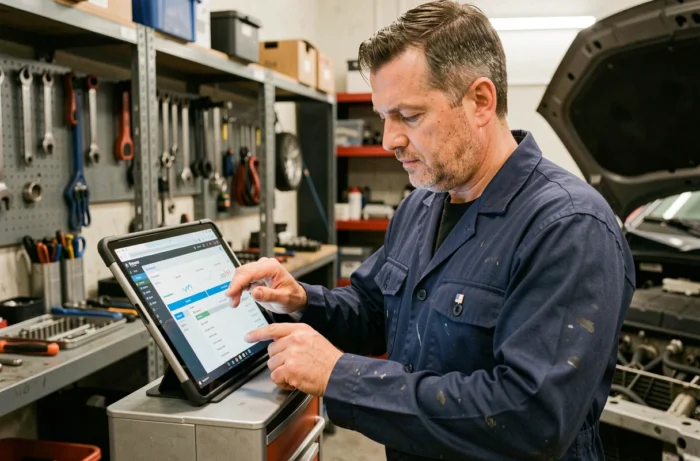
The independent automotive repair market is facing dual pressure: increasingly digitized vehicles and unequal access to technical data among players. Autossimo, the portal developed by Autodistribution, occupies a unique position in this context. As a multi-brand spare parts referencing and ordering platform, the tool equips several thousand workshops in France.
Its dominant position in parts distribution is established, but the question of its real role in the face of sector changes deserves closer examination.
Access to vehicle data: the weak link for independent repairers
Before discussing catalogs or orders, the primary issue for independent garages is technical. A European survey cited in 2025 indicates that 48% of independent repairers have read and write access to vehicle data, compared to 93% for manufacturer-approved networks. This gap summarizes a field reality: ordering the right part is useless if the workshop cannot query the vehicle’s computers to make a reliable diagnosis.
Autossimo remains primarily a spare parts referencing and quoting tool. It does not, on its own, fill this gap in access to diagnostic and repair data. Professionals who use it daily generally complement it with separate diagnostic software, subscriptions to manufacturer portals, or even third-party tools for reading electronic control units.
For those wishing to delve deeper into Autossimo’s role in the garage ecosystem, it is possible to discover Passion Auto Méca and its dedicated analysis on the subject.
Parts ordering and workshop management: what Autossimo does concretely
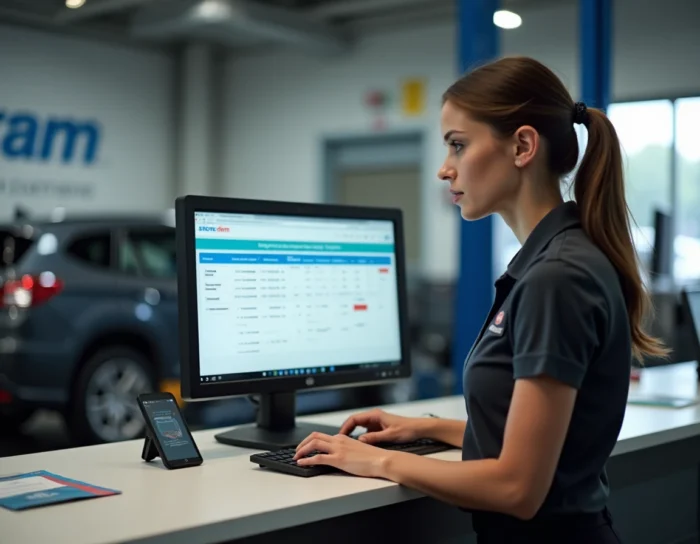
Where Autossimo provides measurable value is in the time spent searching for parts. During the 2017 overhaul, Autodistribution announced an average reduction of twelve seconds per search. When applied to the millions of annual queries made via the platform, the cumulative gain translates into tens of thousands of hours freed up for repairers and store sellers.
The platform allows users to identify a part based on the vehicle’s registration, refine by technical criteria, and then place an order with the nearest distributor. This shortened circuit between diagnosing the need and delivering the part remains the core of Autossimo’s offering. The integrated functions also cover:
- The creation of customer quotes directly from the interface, with automatic calculation of standard labor times
- Access to a multi-brand catalog covering almost the entire French vehicle fleet, including mechanical and electronic parts
- Consultation of technical data (assembly diagrams, torque specifications, manufacturer recommendations) for certain common operations
However, the complete management of a workshop exceeds Autossimo’s scope. Planning interventions, accounting, customer relations, or warranty tracking require complementary garage management software. Several publishers (GestAtelier, BeMaestro, among others) offer solutions that interface with Autossimo, but integration is not always seamless.
European Data Act and connected vehicles: a shift that redefines tools
Since September 12, 2025, the European Data Act allows users of connected vehicles to request access to the data generated by them and to transmit it to a third party, such as an independent repairer. This regulation changes the game for the entire industry.
Autossimo could evolve from an ordering catalog to an intermediary for connected services. The idea would be to integrate, in addition to parts referencing, data flows directly from the vehicle: fault codes, electronic maintenance history, predictive maintenance alerts. But this perspective remains contingent on several concrete factors.
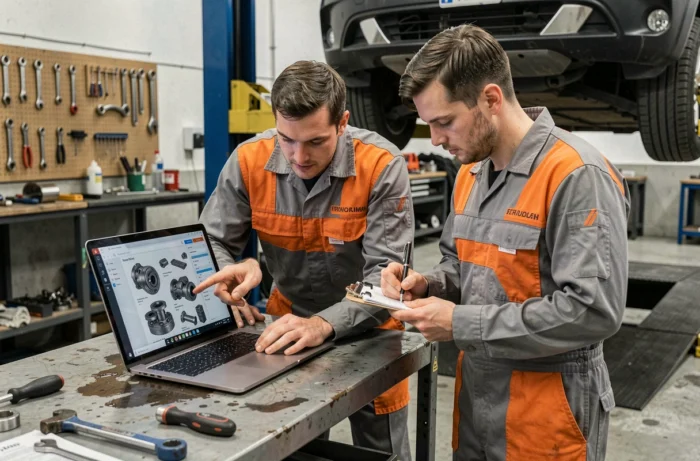
First, customer consent is required for each data transmission. Next, manufacturers may charge for access to certain technical information, creating an additional cost for the garage. Finally, compliance with GDPR imposes a secure framework that any platform must guarantee before processing these flows.
The field data collection conducted by Mobilians, launched on June 20, 2026, aims to document the operational difficulties faced by professionals in accessing technical information about vehicles. Feedback from the field varies on this point: some well-equipped workshops with diagnostic tools do not expect much from Autossimo in this area, while others, less equipped, see it as a lever for technological catch-up.
Limits of Autossimo in the face of the rise of integrated diagnostic tools
The landscape of digital tools for automotive workshops has become denser. Solutions combining diagnostics, parts ordering, and administrative management in a single interface are beginning to emerge. Autossimo’s model, centered on spare parts distribution with some peripheral functions, faces competition that seeks to unify the entire repair process.
A parts catalog, even exhaustive, is no longer sufficient to secure the relationship with a workshop whose needs extend to electronic diagnostics, ADAS sensor calibration, or ECU reprogramming. The shift towards electric and hybrid vehicles accentuates this trend: traditional mechanical interventions decrease in proportion, while software operations take over.
Autodistribution has repeatedly indicated its intention to evolve Autossimo beyond a simple ordering portal. The available data does not yet allow for measuring the actual scope of this transformation or its deployment timeline. What is observable is that the value of a repair tool is now judged by its ability to integrate vehicle data, parts, and management into a single flow.
Autossimo retains a structural advantage: its affiliation with the Autodistribution network gives it a logistical network that few digital competitors can replicate. The quick delivery of spare parts to workshops remains a decisive criterion for professionals, and in this area, the platform delivers on its promise.
The open question is its ability to also become a diagnostic and management tool, or to remain confined to a role as an intelligent catalog in an increasingly fragmented ecosystem.