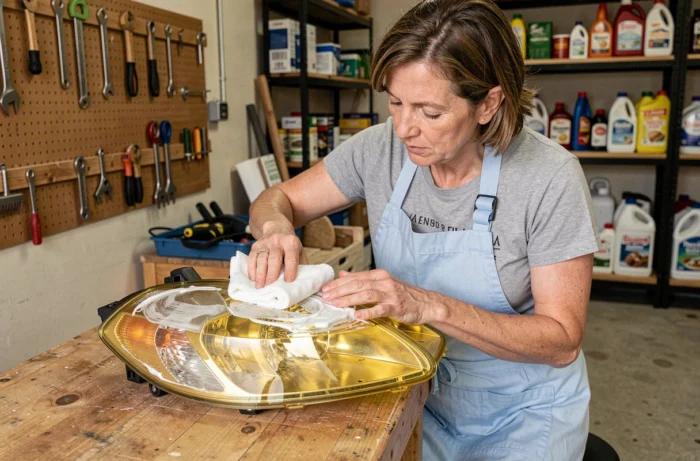
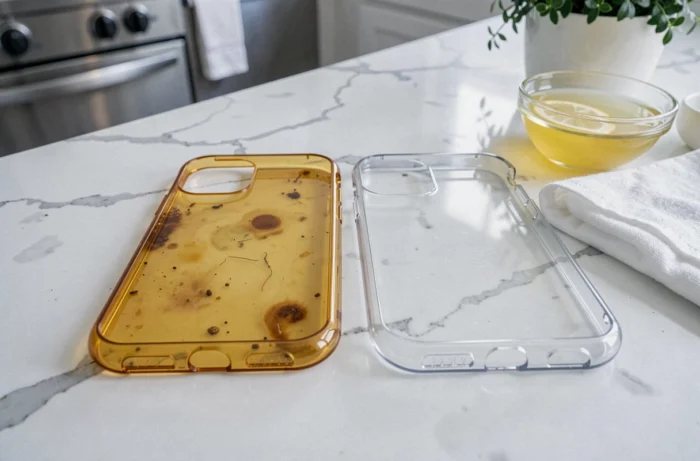
Transparent plastic yellows due to the combined effects of UV rays, oxygen, and heat. Cleaning and reviving this yellowed plastic requires understanding what happens at the molecular level, then choosing the right agent based on the type of plastic and the degree of degradation. The result depends as much on the method as on the precautions taken before, during, and after the treatment.
Comparison of agents for whitening yellowed transparent plastic
Not all products are equal. Their effectiveness varies according to concentration, application time, and the type of targeted plastic. This table summarizes the main options available for cleaning yellowed plastic.
| Agent | Mode of action | Indicative application time | Main precaution |
|---|---|---|---|
| Hydrogen peroxide | Targeted oxidation of yellowed chromophores | Several hours to a day, under UV light | Wearing gloves and goggles beyond 8% concentration |
| Baking soda (paste) | Gentle abrasion + slight alkalinity | Several minutes of scrubbing | Risk of micro-scratches on glossy plastic |
| White vinegar | Dissolution of surface deposits (grease, limescale) | Soaking for 30 min to 1 hour | Ineffective on deep yellowing (photo-oxidation) |
| Citric acid | Mild bleaching agent, chelation of minerals | Soaking for 1 to 2 hours | Thorough rinsing to avoid a sticky film |
Hydrogen peroxide remains the most documented agent for treating UV-related yellowing. Vinegar or baking soda solutions act more on the surface: they remove grime and greasy deposits but do not alter the plastic’s chemistry deeply. If you want to know how to clean yellowed transparent plastic, the distinction between surface dirt and molecular alteration dictates the choice of product.
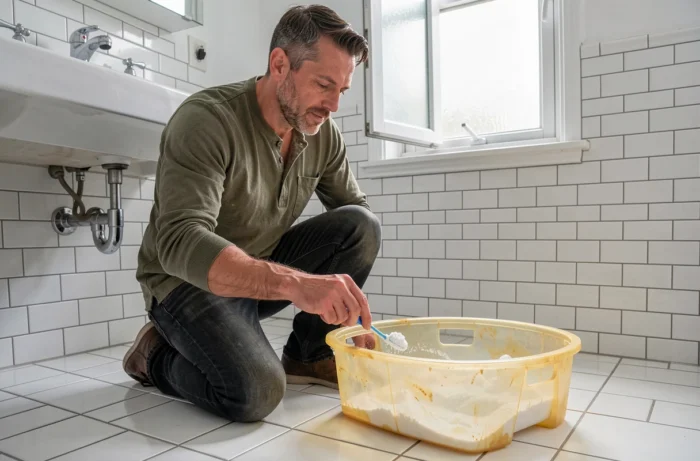
Photo-oxidation of transparent plastic: what yellowing reveals about the structure
The yellowing of transparent plastic is not just an aesthetic issue. Under the effect of ultraviolet rays, polymer chains break and form chemical groups called chromophores, responsible for the yellow hue.
In the case of ABS (acrylonitrile butadiene styrene), this photo-oxidation process weakens the surface and decreases impact resistance. Transparent polycarbonate can develop a haze accompanied by a loss of mechanical properties. Cosmetic whitening does not restore the lost strength.
This distinction matters: on a transparent object with a protective function (greenhouse glazing, visor, protective shell), reviving the color without assessing the mechanical state amounts to masking a structural weakness. For polycarbonate, sustainable solutions are more about prevention (UV-stabilized quality, protective film) than post-cleaning.
Hydrogen peroxide and the retr0bright method: real effectiveness and time limits
The retr0bright method, popularized by collectors of retro computer equipment, involves applying a hydrogen peroxide-based gel to the yellowed surface, then exposing the object to UV light (sun or lamp). The immediate visual results are often spectacular on white ABS.
A result that can reverse over the years
A ten-year follow-up report indicates that a Dreamcast console case treated with retr0bright has become yellower than the untreated area, with visible marks and color differences. This isolated case does not constitute a controlled trial, but it raises a point that most tutorials overlook: bleaching with peroxide can be reversible over time.
The treatment oxidizes the chromophores on the surface without altering the internal composition of the polymer. If the object is re-exposed to UV light after treatment, yellowing may resume, sometimes unevenly.
Concentration and safety
Oxidizing creams for hair (9% or 12% peroxide) are the most commonly used as the base for the retr0bright gel. Beyond 8% concentration, the product is classified as potentially causing serious eye damage. Wearing protective goggles and nitrile gloves is required, without exception.
- Apply the gel in an even layer with a brush to avoid drips and unevenly treated areas
- Cover the piece with transparent cling film to maintain contact and limit evaporation of the peroxide
- Monitor progress every hour: too long an application time can excessively whiten certain areas and create a splotchy result
Precautions before treatment: identifying the type of transparent plastic
Not all transparent plastics react the same way. An abrasive treatment suitable for PMMA (plexiglass) can irreparably scratch polycarbonate. Conversely, a solvent tolerated by polycarbonate can dissolve polystyrene.
- PMMA (plexiglass): tolerates soft baking soda pastes but fears chlorinated solvents and concentrated alcohol
- Polycarbonate: sensitive to micro-scratches, prefer a damp microfiber cloth and avoid any product containing ammonia
- ABS: responds well to retr0bright, but the surface can become powdery if UV degradation is advanced
- Transparent PVC: white vinegar and citric acid are suitable for surface deposits, but deep yellowing is rarely reversible
Before any application, test the product on a discreet area and wait at least an hour to assess the reaction. A plastic already weakened by oxidation may crack under the effect of an overly aggressive chemical agent.
Prevention of yellowing: what works upstream
Curative treatment has its limits. On transparent polycarbonate, choosing UV-stabilized quality at the time of purchase remains the most effective measure. UV protective films applied to the surface measurably slow down photo-oxidation.
For objects already in place, reducing direct exposure to sunlight and heat remains the simplest lever. Storing a transparent plastic object in a cupboard rather than on a windowsill radically changes its aesthetic lifespan. Regular cleaning with a damp microfiber cloth also limits the accumulation of grease and particles that accelerate surface oxidation.
De-yellowing transparent plastic remains possible in most cases, provided that the method is adapted to the material and that one accepts that the result may evolve over time. For a valuable or technically functional object, prevention protects better than restoration.