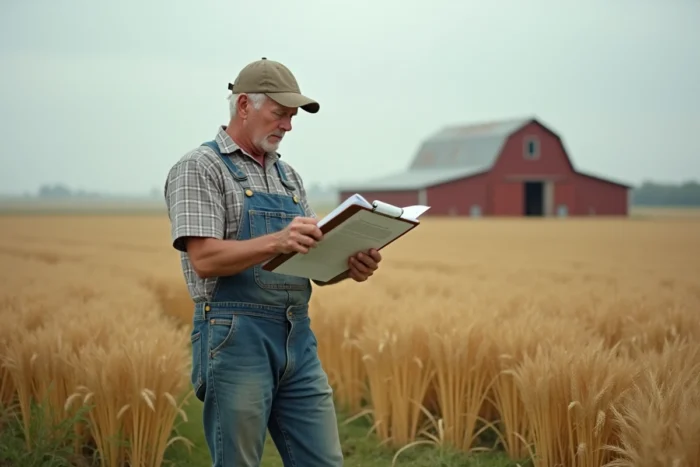
A hailstorm on a wheat field in June, a fire starting from a dry ditch in August, a flood sweeping away the stored fodder along the edge of the field: each season brings its share of disasters on farms. Taking out a multi-risk agricultural insurance allows for grouping these hazards under a single contract, instead of multiplying policies for each isolated risk.
Fallow land and unused plots: the trap of exclusions
It is often thought that multi-risk coverage automatically applies to all declared plots. In reality, the situation is harsher. Farmers report refusals of compensation for brush fires that occurred on unused or fallow land.
The problem arises from the contractual definition of the covered plot. A piece of land that is neither cultivated nor maintained may be considered by the insurer as outside the scope of the contract, even if it belongs to the farm. Ensuring that fallow plots are explicitly listed in the contract avoids disputes at the time of the disaster.
Before signing, it is advisable to list all plots, including those in rotation or resting, and to request their explicit inclusion. This is a negotiation point when taking out a multi-risk insurance for agricultural land, and it makes all the difference in the event of a disaster in a peripheral area of the farm.

Multi-risk insurance and CAP aids: a subsidy condition since 2025
Since January 2025, the reform of the Common Agricultural Policy requires multi-risk insurance covering agricultural land to receive European subsidies. The measure is not retroactive, but it strictly applies to new aid application files.
In practice, a farmer submitting a CAP file without being able to justify an active multi-risk contract risks having their application rejected or suspended. Multi-risk insurance has become an administrative prerequisite, not just a financial protection.
For farms that previously operated with just a fire policy or theft coverage, the change is significant. It is no longer a matter of management choice but a conditional obligation linked to the financing of the farm.
Deductible, compensation, and yield: what the contract really covers
The term “multi-risk” gives the impression of total protection. In practice, each guarantee comes with a deductible and compensation limits that must be understood before signing.
The basic guarantees of a multi-risk agricultural contract
A standard contract generally includes:
- Fire, explosion, and lightning coverage on buildings, agricultural equipment, and stocks (crops, fodder, stored inputs).
- Damage related to weather events: hail, storms, frost, flooding. This is the area that has evolved the most in recent years due to the increase in climate-related disasters.
- Professional civil liability, which covers damages caused to third parties in the course of agricultural activity (accidental pollution of a watercourse, falling tree on a road, injury to a visitor).
- Theft and vandalism of equipment and buildings, with varying conditions depending on the insurer (required security devices, coverage hours).
Deductible and calculation of compensation on crops
The deductible represents the portion of the loss that remains the responsibility of the farmer. It can be expressed as a percentage of the insured yield or as a fixed amount. For crops, compensation is often calculated based on a historical reference yield.
An undervalued reference yield mechanically reduces compensation, even in the case of total loss. It is in one’s best interest to verify the calculation method used by the insurer and to provide updated yield data when taking out the policy.
Feedback varies on this point: some insurers agree to revise the reference yield annually, while others freeze it on a multi-year average. The difference in compensation can be considerable after a poor harvest.
Agricultural multi-risk vs. single-service policies: why the single contract is gaining ground
Until recently, many farmers accumulated several separate contracts: one for fire, one for theft, one for liability. This fragmented approach poses two concrete problems.
The first is the risk of coverage gaps. Between two contracts, some disasters fall into a gray area. A fire caused by lightning that also damages equipment stored outside may require two separate claims, with overlapping deadlines and deductibles.
The second is the overall cost. Single-service policies have been declining since mid-2024, partly because they end up being more expensive than the equivalent multi-risk contract when premiums are added together. Grouping guarantees under a single contract simplifies management and often reduces the annual bill.
Adapting coverage to increasing climatic risks on agricultural land
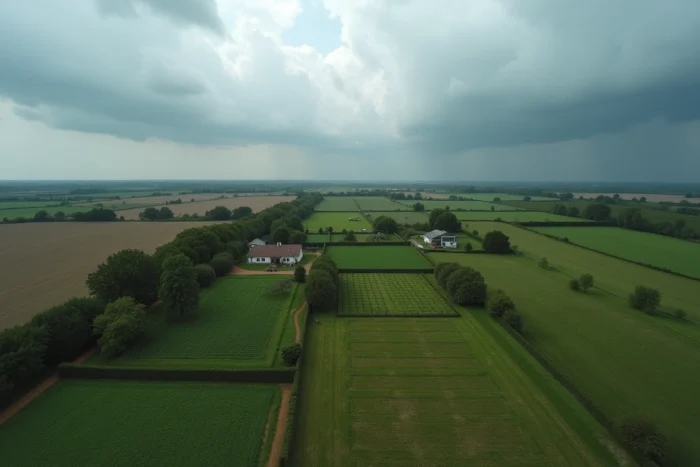
Agricultural insurers are noticing a significant increase in claims related to severe weather, including on bare land without crops in place. Prolonged droughts that crack soils and weaken buildings, torrential rains that wash away plots: the risk profile of agricultural land changes from year to year.
Since 2024, several insurers have begun to incorporate enhanced clauses against prolonged droughts in their multi-risk contracts. Explicitly requesting this extension when renewing the contract helps anticipate a refusal of compensation for a heat-related disaster.
Comparing offers from different insurers remains the best method to obtain coverage tailored to the reality of one’s plots. Differentiation criteria focus on the level of deductible, compensation limits by type of disaster, and the flexibility of annual contract revisions. A farmer cultivating in a flood-prone area does not have the same needs as a cereal grower on a limestone plateau, and the contract must reflect this difference.