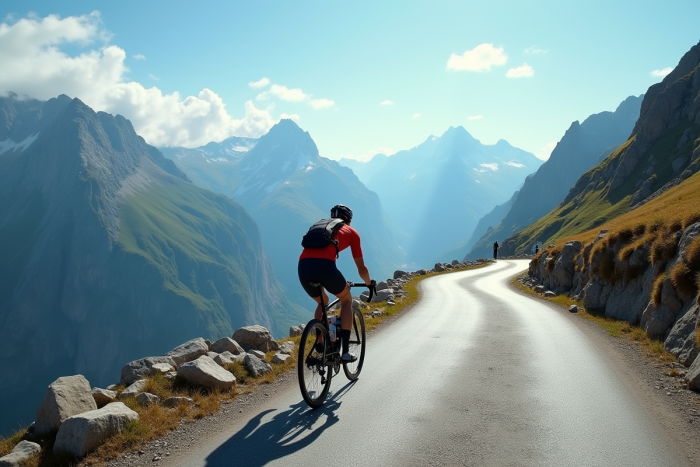
The winding roads of the Alps and the Pyrenees are much more than mere routes for cyclists; they are the pages where the history of cycling is written. Every turn, every ascent, echoes with the feats of legendary champions.
Passes like the Galibier or Alpe d’Huez have forged heroes, standing as monuments of challenge and glory. Spectators, gathered along the roads, pulse with the rhythm of the pedals, witnesses to a fierce struggle between man and mountain. Between ancient myths and contemporary performances, these stages continue to fascinate, embodying the very essence of cycling.
The mythical passes: extraordinary challenges
Cycling is a discipline where challenge and legend meet on the steep slopes of mythical passes. The Col du Galibier, rising to 2,642 meters above sea level, is one of these giants. With an ascent of 34.9 km and an average gradient of 5.5%, it has been crossed 61 times in the Tour de France. Memorable moments, such as Andy Schleck’s attack in 2011 and Nairo Quintana’s victory in 2019, have been forever etched there.
The Alpe d’Huez, famous for its 21 bends, offers an ascent of 13.1 km with an average gradient of 8.19%. Feats succeed one another, like Christophe Riblon’s victory in 2013. This pass is a theater of dramas and triumphs where each numbered turn recalls the trials of the riders.
- Col du Tourmalet: 18.3 km of ascent, average gradient of 7.7%, crossed more than 80 times. Gustave Lapize immortalized his famous phrase here in 1910.
- Col de la Madeleine: 19.2 km of ascent, average gradient of 8%, crossed 13 times. Julian Alaphilippe left his mark on this pass in 2018.
- Mont Ventoux: 21 km of ascent, average gradient of 7.5%, rising to 1,912 meters. Its lunar topography and violent winds have been described by Eddy Merckx.
These passes are not just physical challenges. They are symbols, places where the past and present meet. The legendary ascent of Cavendish at Plateau de Beille is a striking example, reminding us that every climb is a new page in the history of cycling. 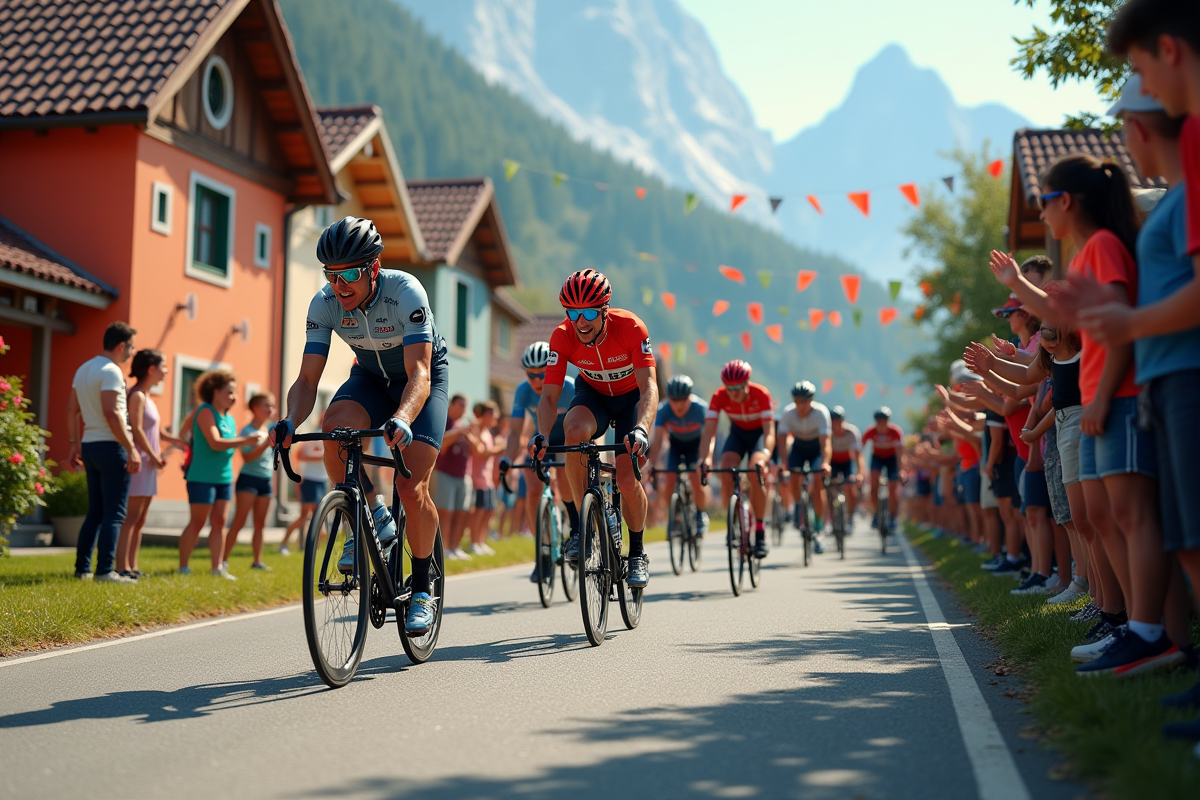
The feats that marked the history of cycling
Cycling, beyond physical challenges, is a discipline where the feats of riders become legends etched in collective memory. Eddy Merckx, often called ‘The Cannibal’, dominated the roads of the Tour de France in an unmatched manner, winning five editions between 1969 and 1974. His performance on Mont Ventoux in 1970, despite extreme weather conditions, remains an iconic moment.
Fausto Coppi and Gino Bartali marked the history of cycling with their intense rivalry and successive victories. Coppi, known for his climbing abilities, triumphed on legendary routes like the Col du Galibier, while Bartali, with his two Tour de France victories in 1938 and 1948, embodied resilience.
The memorable duels
- Jacques Anquetil and Raymond Poulidor: their duels, particularly during the Puy de Dôme stage in 1964, captivated spectators and symbolized the struggle between two cycling styles, one methodical and the other more instinctive.
- Bernard Hinault: nicknamed ‘The Badger’, he won five Tours de France and remains famous for his combative spirit, especially during the Alpe d’Huez stage in 1986.
The feats of these champions are not limited to the Tour de France. Julian Alaphilippe’s victory at the Col de la Madeleine in 2018 proved that modern cycling continues to write its history with moments of bravery and determination. The names of these riders still resonate on the legendary roads, reminding us that each stage is a new opportunity to climb the heights of glory.