Choosing kitchen utensils is less about quantity and more about the versatility of each piece, its durability, and its compatibility with regulatory changes affecting cooking materials.
Cooking Materials: What Restrictions on PFAS Change
Pans and pots are the area where the choice of material has the most significant impact, both on cooking quality and the longevity of the equipment. Since 2023, several European health and regulatory authorities have been working to restrict PFAS, these per- and polyfluoroalkyl substances found in certain non-stick coatings.
This regulatory pressure accelerates the shift towards three families of materials with significantly different properties.
| Material | Thermal Conductivity | Maintenance | Estimated Lifespan | Oven Compatibility |
|---|---|---|---|---|
| Stainless Steel 18/10 | Medium (heats slowly, even distribution) | Easy, dishwasher safe | Very long (several decades) | Yes |
| Raw or Enamelled Cast Iron | Slow to heat, excellent retention | Immediate drying, seasoning for raw cast iron | Very long | Yes |
| Ceramic (coating) | Fast | Fragile to thermal shocks | Medium (the coating wears out) | Depends on the model |
For the majority of home cooking (searing meat, sautéing vegetables, simmering a sauce), a stainless steel pan and a cast iron pot cover almost all needs. Stainless steel requires a bit of fat and a gradual increase in temperature, but it does not suffer from any degradation of coating.
Those exploring the world of Gourmandises et Cie will find ranges that reflect this transition towards more sustainable materials, far from disposable non-stick options.
Knives and Cutting Utensils: Three Blades Are Enough
Sets of twelve knives sold in blocks are rarely utilized beyond two or three pieces. Philippe Etchebest sums it up well: three quality knives replace a dozen mediocre blades.
- A paring knife (blade of 8 to 10 cm) for precision tasks: peeling, mincing garlic, turning a vegetable.
- A chef’s knife (blade of about 20 cm) for daily cuts: vegetables, herbs, boneless meats.
- A bread knife (serrated blade) that also works for thick-skinned tomatoes and certain fruits.
The determining factor remains the steel. High-carbon steel retains its sharpness longer but requires regular maintenance with a honing steel or stone. Classic stainless steel is more forgiving of neglect, in exchange for more frequent sharpening.

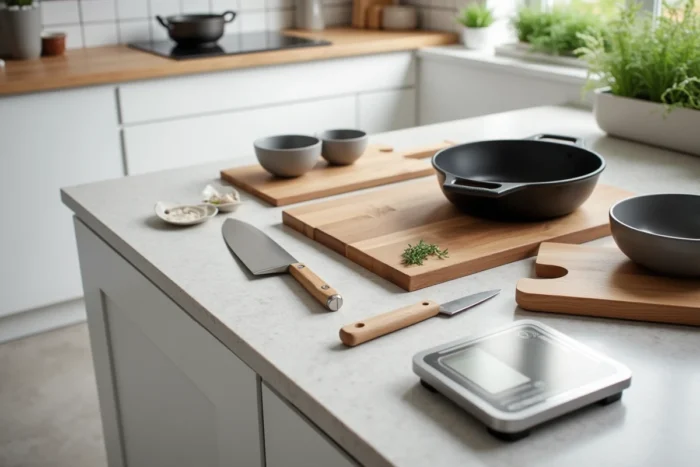
The cutting board accompanies this trio. Wood (maple, beech) preserves the edge of the blades better than glass or hard plastic. A thick board, made from a single type of wood, does not warp and can be sanded down after a few years of use.
Multifunction Devices vs. Single-Use Gadgets
Sales of multifunction robots, heating blenders, and air fryers are steadily increasing, while single-use devices (sandwich maker, yogurt maker, egg cooker) are declining.
This shift reflects a simple logic: a device that replaces three gadgets frees up counter space and reduces the overall budget. A multifunction robot capable of kneading, blending, cooking, and emulsifying replaces the mixer, blender, and sometimes the steamer.
However, not all multifunction devices are equal in heating power or bowl capacity. Before investing, check two points:
- The motor power for thick preparations (bread dough, nut puree): below a certain threshold, the motor struggles, and lifespan decreases.
- The availability of spare parts and coverage by the reparability index, established in France in 2021 for several categories of household appliances and gradually extended to other devices.
A repairable device with available spare parts lasts two to three times longer than a model with rapid obsolescence sold for a few dozen euros less.
Measurement, Temperature, and Precision: Often Neglected Tools
The success of a recipe often hinges on the precision of quantities and temperatures, not on the number of spatulas in the drawer. Three tools change the reliability of results.
A kitchen scale accurate to the gram replaces the measuring cup for all dry measurements. Flours, sugar, butter: their densities vary, and the volume/weight conversion introduces discrepancies that accumulate in baking recipes.
A probe thermometer allows for precise control of meat cooking and sugar cooking without cutting or guessing. The cooking point of a roast chicken or caramel depends on a few degrees, not on a visual estimate.
A well-adjusted mandoline, finally, produces slices of consistent thickness, which standardizes cooking times (gratin, vegetable chips, carpaccios). It replaces the uncertain gesture of the knife for repetitive fine cuts.
Repairability and Lifespan: The Cost per Year of Use
The reparability index, implemented in France since 2021 according to the Ministry of Ecological Transition and Ademe, already covers several categories of household appliances. Its gradual extension encourages manufacturers to document the availability of parts, ease of disassembly, and access to technical documentation.
Applying this framework to your kitchen purchases means favoring detachable stainless steel over welded plastic, screw handles over riveted handles, and brands that publish their spare parts catalogs. A stainless steel pan with a replaceable handle after ten years costs less overall than a succession of non-stick pans replaced every two or three years.
The initial budget is higher. The cost per year of use is consistently lower for durable and repairable equipment. This ratio matters more than the price displayed on the shelf at the time of purchase.