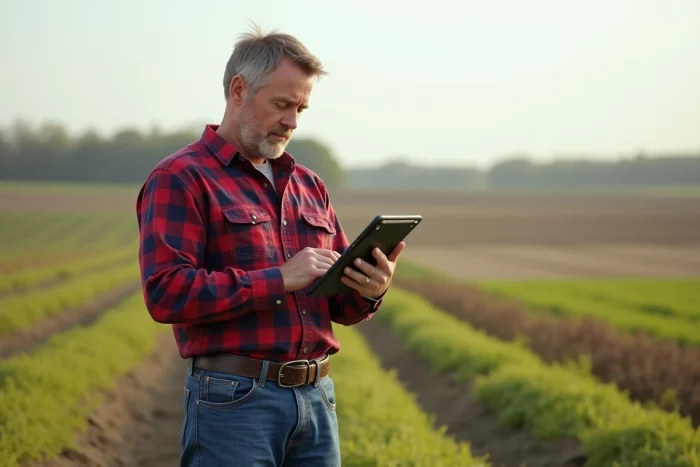
Temperature differences of four degrees across two neighboring plots, unexpected showers where the weather forecast promised a blue sky: this is the daily reality for many farmers facing the complexities of microclimates. Professional tools capable of embracing this complexity are beginning to stand out, while more general solutions struggle to account for the diversity of the terrain.
The relevance of forecasts depends not only on the quality of the collected data but also on how they are interpreted and adapted to the requirements of each farm. In this landscape, the choice between a free application or an expert service is never trivial: each option shapes decision-making in the field, and every compromise affects crop management.
Why agricultural weather has become an indispensable tool for farmers
Agricultural weather is no longer just a bulletin to be consulted casually. It has become a strategic ally for the agricultural sector. Farmers today seek refined weather forecasts, tailored to their needs, based on hyper-local weather data and, increasingly often, connected weather stations installed directly on their plots. Sensors, algorithms, and cross-analyses: these devices pave the way for concrete anticipation, whether it’s planning sowing or adjusting irrigation.
Climate risks are intensifying and blurring established benchmarks. Climate change does not merely shift seasons: it imposes constant adaptation. Off-season frost events, persistent droughts, or sudden downpours force farmers to reassess fertilization, treatments, and harvest dates in real time. To achieve this, they rely on decision support tools (DST) that combine agronomic data and nearby weather, sharpening day-to-day crop management.
The best agricultural weather on Instant Jardin is part of this dynamic, focusing on the precision of its forecasts and the use of spatialized data. Each user benefits from detailed analyses, adjusted to the reality of their plots, while remaining in control of the interpretation.
Connected weather stations deploy their network of sensors to continuously measure temperature, rainfall, humidity, wind, and radiation. These readings, combined with high-performance weather models, provide precise alerts: forecasted frost, upcoming heatwaves, heavy rain. The result: enhanced anticipation, finer management, and ongoing adaptation to the changing climate that governs French farming.
Which applications and resources to choose for truly reliable forecasts?
The quality of today’s agricultural weather forecasts relies on the rigor of the collected data and the effectiveness of digital models. Applications designed for agriculture no longer just indicate temperature or the likelihood of rain: they integrate satellite data, measurements from connected weather stations, and field observations to provide a comprehensive and localized view. Now, weather has become a daily tool, accessible on smartphones or computers, designed to support every decision.
In France, some services rely on the robustness of models like Arôme, ICON, or GFS, enhanced by sensor networks. This combination ensures increased reliability: hourly forecasts, detection of localized hazards, precise management of irrigation and treatments. Next-generation agricultural applications offer personalized alerts for each plot, interactive risk maps, and a weather history that can be consulted at any time.
The real advantage is the ability to adapt the weather forecast to each farm and each crop. This customization transforms weather information into a crucial resource. The farmer, better informed, adjusts their practices, anticipates unforeseen events, and optimizes their interventions. The most effective tools offer clear, intuitive interfaces, making weather accessible to the realities of the field. Raw data transforms into a strategic resource that directly influences the performance and resilience of farms.
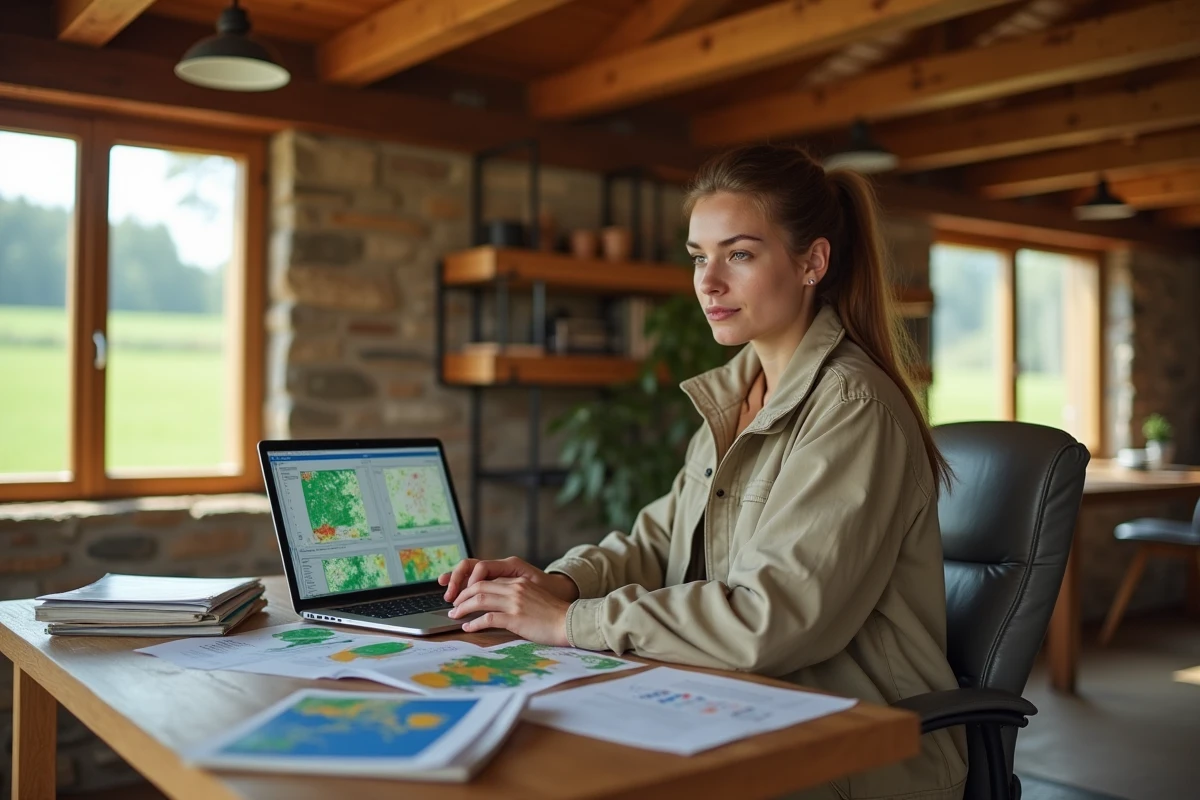
Integrating weather into daily crop management: the concrete benefits at stake
Considering weather data is no longer limited to checking the day’s weather. Thanks to decision support tools (DST), every piece of information collected becomes a lever for action in the field. On a plot, sensors and data networks transmit precise measurements several times a day. Among the monitored parameters are:
- temperature
- rainfall
- humidity
- wind
- atmospheric pressure
- sunshine
- cloud cover
- dew point
- evapotranspiration
- water deficit
- growing degree days
Today, weather integrates with all the data that drives farm management. Algorithms transform these measurements into concrete forecasts: disease emergence, risks of water stress, frost threats. The fine modeling of atmospheric phenomena allows for precise adjustments to irrigation, treatments, or protection against extreme events. Alerts generated by some DSTs warn as soon as critical thresholds are reached: unexpected frosts, persistent heatwaves, torrential rains, sudden winds. Decisions are based on scenarios built from historical series and real-time data, coupled with agronomic data specific to each crop.
The contribution of spatialized data from rain radars allows for targeting precipitation at the scale of each production zone. Agrivoltaic installations, by modulating light and temperature, offer a new margin of maneuver to preserve yield and protect crops from excesses. Precision agriculture draws on this weather intelligence to limit losses, secure harvests, and adapt practices, one day at a time, to the unpredictability of the climate. This is what makes the difference between enduring the weather and using it as a true lever: agriculture that observes, analyzes, and acts, without waiting for the next bulletin.